A Few Remarks on “Minor Matters”
Group exhibition (2013)

Nekoliko reči o “malim stvarima”
(u postsocijalizmu)
A Few Remarks on “Minor Matters”
Group exhibition (2013)
In September 2013 Kontekst collective as a guest curators took part at the exhibition “Unexpected Encounters” in the gallery Camera Austria in Graz, together with 0gms from Sofia (Bulgaria) and collective Beirut from Cairo (Egypt). The exhibition was part of the festival Styrian Autumn (Steirischer herbst 2013).
Brief concepts of each project parts/art works that was part of the Kontekst collective’s curatorial gest:
Bojana Piškur (REC) & Djordje Balmazović (Škart), Workers Inquiry (Belgrade – Novi Sad), on-going, fanzine
Bojana Piškur, member of Radical Education Collective and a curator in Moderna galerija Ljubljana together with Djordje Balmazović from Škart collective conducted a common research investigation Workers Inquiry based on Marx’ Workers Inquiry (WI), which was concerning with the positions of cultural workers in Serbia. The research took place in Belgrade and Novi Sad in September 2012. The aim of the investigation was to disclose the modes and different levels of exploitation of the cultural workers as well as the ways in which to employ this newly produced knowledge to work towards social transformation.
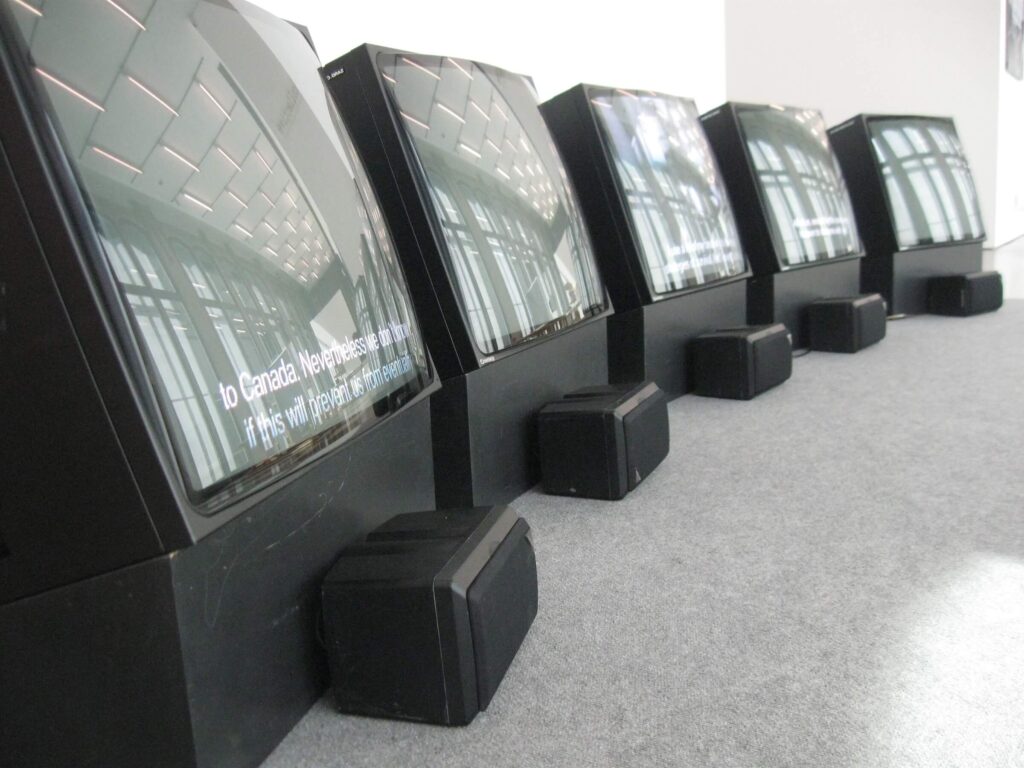
Kontekst collective, On Solidarity, video, 2013
Student protests, based on the principle of plenum as a direct democratic student body are an increasingly present phenomenon at the universities of Belgrade, Zagreb, Ljubljana, Rijeka, Novi Sad, and other cities in this region. Even though it may not be a universally known fact, student protests based on the principles of direct democracy were also a very popular form of organization in the revolutionary student movements at the universities of Belgrade and Zagreb between the two World Wars. The basic aim of the video is to actualize a part of the forgotten history of the revolutionary student movements in the Kingdom of Yugoslavia, and to emphasize the students interconnectedness, struggle, communication, and solidarity, which often exceeded the limits of the student movements.
KURS, Untitled, wall painting and drawings, 2013
Our art practice is often based on visual representations of historical events that we combine with contemporary social and political context.
Nina Hoechtl, Tales of protest. A necessity, video installation, 2009
I spent a one-month residency in Belgrade in 2008, researching into the fight of the workers from the factory Jugoremedija in Zrenjanin. For two years the workers fought for their factory and against the privatization of their work place. In 2006, Jugoremedija became the first factory amongst the “transition” countries in Eastern Europe undergoing neo-liberal privatization to be recovered and controlled by its workers. The conversations with the workers and witnessing their protest triggered to question my own position as an artist and framer of the workers’ struggle: What am I fighting for? Do I let anything be done to myself?
Kontekst collective, A Sketch for the Possibility of Art against Neoliberal Capitalism, video documentation of the performance act, 2012
We based the arguments presented in the performance on the theses that are an outcome of 2 years work on the project Kontekst, struggle for autonomous space. The manifest itself and the performance represent a paraphrase of a gesture made by the artist Mirko Kujačić in 1932 that happened in a political context that represents an important reference point for our research and a possibility of deliberation of alternatives to the contemporary capitalist system. The performance act was developed as part of the project Oktobar XXX: Exhibition–Symposium–Performance by curator and author Jelena Vesić.
Excerpt from the exhibition text:
The times of open oppression are mostly times when much is said about great and noble things. In such times, it takes courage to speak about things so unworthy of being mentioned as food and workers’ housing, amidst so much noise being made to the effect that the most important thing is to make sacrifice.
Bertold Brecht
1.
The case of the workers of the “Jugoremedija” factory and their struggle to realise their rightshas a special place in the recent history of the workers’ movement in postsocialist Serbia. During the era of socialist Yugoslavia this factory was merely one of the many examples of successfully carried out industrialisation of the country, whereas today its case occupies a unique place in the economic-political reality of Serbia. Namely, “Jugoremedija” has become the first factory in Serbia whose workers have managed, through strikes, struggle for their rights and self-organisation, to get back the ownership of the factory, and following a cycle of privatisation, they initiated successful production again. During the course of their strike, the workers realised the necessity of engaging in a broader political struggle, as well as the importance of the solidarity they shared with workers from other companies, and also with members of other movements and organisations struggling for better working and living conditions.
Still, even though the workers of “Jugoremedija” convincingly showed during the period in question (from 1st March 2007 to 27th December 2012) that they can successfully manage the factory themselves, they were constantly exposed to the pressure of market reforms and privatisation, coupled with the state apparatus then in power. The workers’ demands that they be allowed to manage the company themselves were rejected. At the moment of writing this text, pressures have been renewed with a view to destroying this once important pharmaceutical company.
2.
The brief description of the case of the Jugoremedija factory presented above is representative of a part of the landscape of postsocialist Yugoslavia – the context from which we speak about certain aspects of the restoration of capitalism in these parts. Namely, during the 1990’s, the re-establishment of capitalist market economy in the countries of the former Yugoslavia led to mass unemployment, privatisation of social and state resources and production facilities, the destruction of industrial giants, the impoverishment of the population and a severe stratification of society. The redistribution of capital in Yugoslavia presupposed armed conflicts and numerous victims of the opposed elites of various nations in these parts, aided and abetted by international centres of economic and political power and capital, intent on creating a market hegemony. The wars additionally worsened the social conditions of society, led to mass migrations and intensified and legitimised crime. There ensued the deterioration of the social welfare system, developed during the period of socialism, which led many workers into the sphere of grey economy, wherein they were forced into becoming small-scale entrepreneurs in order to fulfil the minimum requirements for sustaining themselves and their families.
Today, the period of real socialism in the former Yugoslavia and its social and economic achievements are for the most part not talked about. And when they do get talked about, it is mostly done in a very problematic manner. The contours of the Socialist Federal Republic of Yugoslavia appeared in the popular front policy and the antifascist movement developed during the course of World War Two, which sets it apart from the other Eastern European socialist countries, whose establishment was mainly a consequence of the development and the geopolitical influence of the Soviet Union. However, one could go a step further here and posit the thesis that the roots of the Yugoslav self-management experiment and socialist regime can be sought in the period preceding the war, a period that actually made possible the subsequent “course of history”. Taking this thesis into consideration, it gets very interesting to ponder the present through the prism of this specific socio-historical period, which, as it appears to us today, is much “closer” to us than the post-World War Two socialist past.
We shall single out several events wherein one can see how the then intellectual proletariat in the Kingdom of Yugoslavia spoke of its material position, and how it tried to change it through solidarity with the working class and joint struggle.
Event no. 1. The manifesto of the artist Mirko Kujačić and “boycotters”
Event no. 2. The revolutionary student protests of the 1930’s in Belgrade and “4th of April”
3.
In his speech entitled “In Defence of Culture”, delivered at the Second Writers’ Congress, held in 1937, Bertolt Brecht very directly connected economic problems with a bad situation in the sphere of culture. After the attack on the economic and political positions of workers had proved successful, after the freedom of association and forming trade unions had been successfully restricted, as was also the case with the freedom of the press and the freedom of assembly, Brecht pointed out that the attack on culture finally had to bear fruit. He concluded that it was not understood fast enough that the destruction of the position of workers and trade unions was precisely the place where culture was attacked as well.